
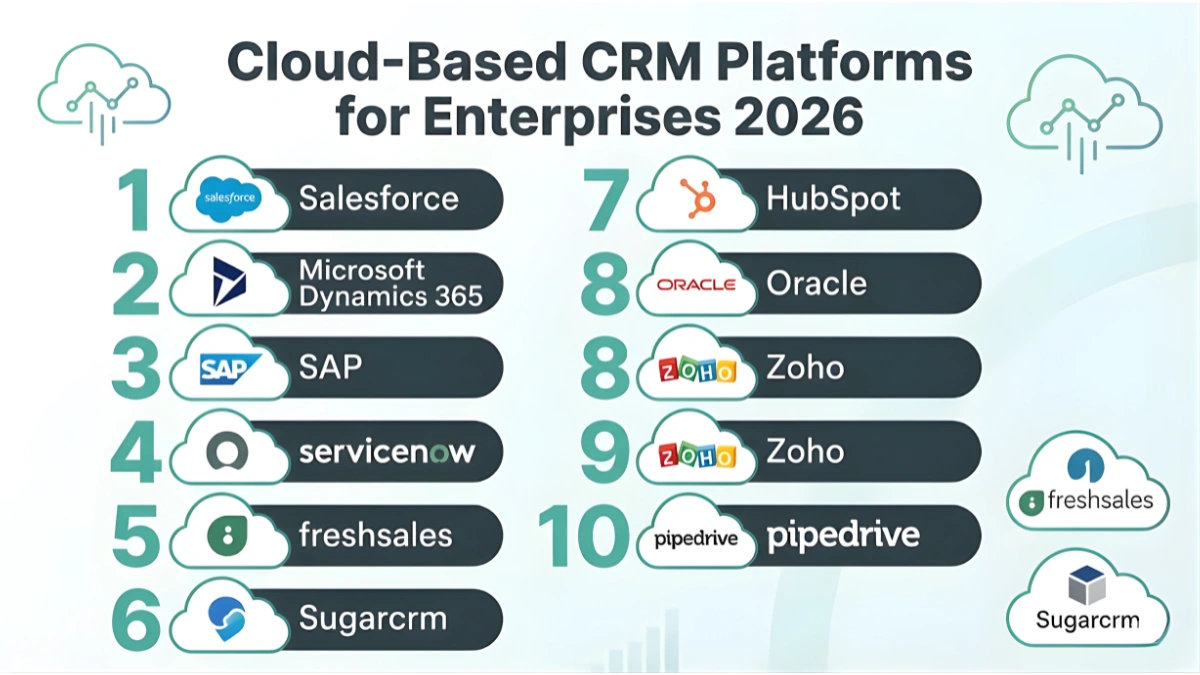
Enterprise businesses now rely heavily on cloud-based CRM systems because customer data, sales workflows, support operations, and analytics must remain accessible across teams and locations. Cloud CRM platforms help large organizations manage complex operations while supporting automation, integrations, and advanced reporting without heavy on-premise infrastructure.
In high-value SaaS and enterprise software markets, keywords related to enterprise cloud CRM, scalable business software, AI CRM systems, and enterprise automation platforms attract strong advertiser demand because large organizations actively compare software before making long-term investments
Why Enterprises Prefer Cloud CRM Platforms
Cloud systems offer flexibility that traditional software often lacks.
Main enterprise advantages include:
- Remote access
- Centralized data
- Easier updates
- Scalable infrastructure
- Lower hardware dependency
This improves business continuity.
Enterprise Cloud CRM Platforms Used Globally
| CRM Platform | Main Enterprise Strength | Suitable For | Pricing |
|---|---|---|---|
| Salesforce Einstein | Deep customization, AI forecasting | Large enterprises | From enterprise tier pricing |
| Microsoft Dynamics 365 | Office integration, analytics | Enterprise operations | $65+ per user |
| HubSpot CRM | Automation, campaign analytics | Growing enterprise teams | $50+ |
| Zoho CRM Plus | AI forecasting, omnichannel tools | Cost-sensitive enterprises | $20+ |
Why AI Matters in Enterprise CRM
AI has become central in enterprise decision-making.
Important AI capabilities include:
- Predictive lead scoring
- Forecast automation
- Customer segmentation
- Opportunity alerts
These improve strategic decisions.
How Enterprise Integrations Improve CRM Value
Cloud CRM platforms usually connect with major business systems.
Important integration areas:
- ERP systems
- Accounting software
- Marketing tools
- Analytics platforms
Security and Governance for Large Businesses
Enterprise CRM adoption depends heavily on control.
Main enterprise requirements include:
- Permission management
- Audit logs
- Compliance tracking
Pricing Trends in Enterprise CRM
Pricing usually rises based on feature depth and user scale.
Enterprise costs often increase because of:
- AI modules
- Advanced integrations
- Support packages
FAQs
1. Why do enterprises prefer cloud CRM?
Cloud systems scale more easily.
2. Which CRM supports strongest customization?
Salesforce remains highly flexible.
3. Is AI necessary for enterprise CRM now?
It is increasingly important.
4. Do cloud CRMs integrate with ERP?
Yes, major platforms support this.
5. Is enterprise CRM pricing always custom?
Often yes for larger deployments.
Conclusion: Cloud-based CRM platforms help enterprises improve scalability, automation, and customer visibility while supporting AI-driven business decisions. Companies adopting strong cloud CRM systems often improve operational efficiency and long-term data control.
Disclaimer: This article is for informational purposes only. CRM features, enterprise pricing, and integrations may change depending on provider updates and subscription plans. Businesses should verify official platform details before selecting software.