
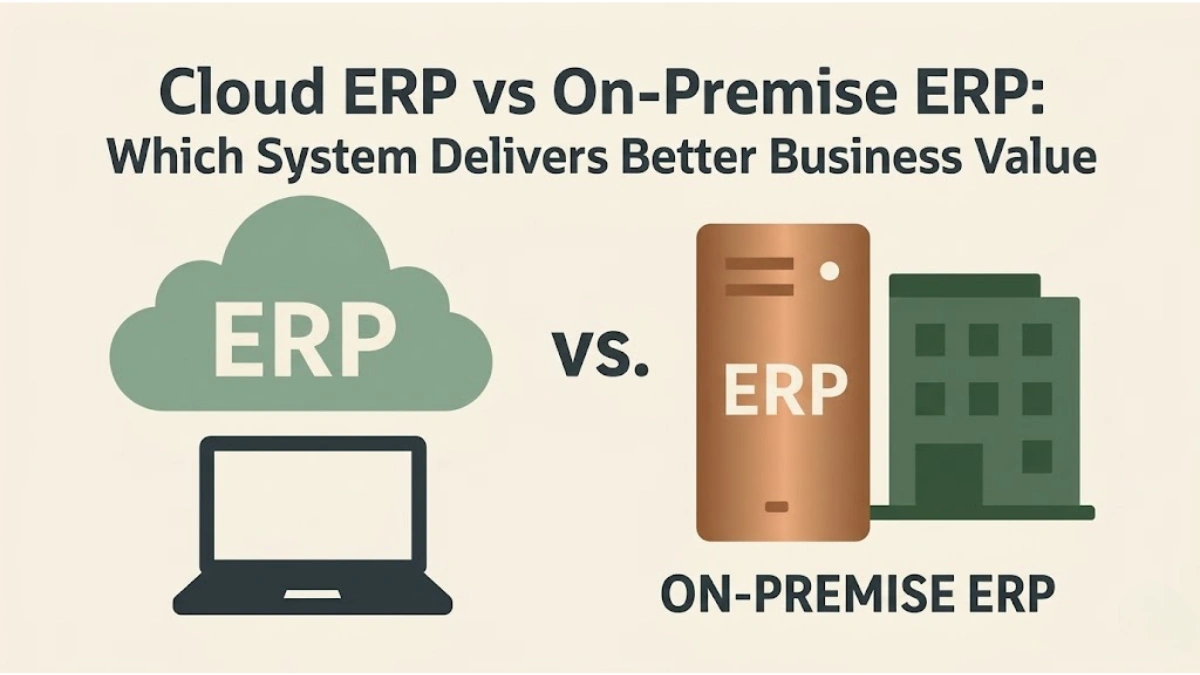
Choosing between cloud ERP and on-premise ERP has become a major decision for businesses because ERP now controls finance, inventory, procurement, production, reporting, and operational planning from one central platform. The deployment model affects not only software cost but also flexibility, data control, scalability, and long-term business efficiency.
Businesses comparing ERP systems usually focus on how quickly the software can be implemented, how easily it can expand with growth, and how much internal technical support is required. The detailed comparison you shared clearly shows that ERP selection is no longer only about software features—it now depends heavily on business structure, technical resources, and long-term digital strategy
What Cloud ERP Means for Modern Operations
Cloud ERP runs through vendor-managed servers and is accessed online.
This model has become highly popular because businesses can deploy it quickly without building large internal infrastructure.
Main advantages include:
- Remote access across locations
- Automatic updates
- Lower hardware investment
- Faster implementation
- Reduced IT burden
Because of this, cloud ERP is strongly preferred by growing businesses and multi-location operations.
How On-Premise ERP Works Differently
On-premise ERP is installed directly on company-owned servers and managed internally.
This gives businesses full control over software environment and internal data handling.
Main strengths include:
- Internal server ownership
- Full customization flexibility
- Internal security control
- Greater upgrade control
Large organizations with strong IT departments often still prefer this model.
Cost Structure Comparison
Cloud ERP usually uses subscription pricing, which spreads cost over time.
This helps businesses avoid heavy initial investment.
Typical cloud ERP costs remain easier to predict because infrastructure maintenance is handled externally.
On-premise ERP usually requires major upfront spending:
- Server setup
- Licensing fees
- Technical deployment
- Internal maintenance
This creates a larger early investment.
Scalability for Business Growth
Cloud ERP usually expands faster when operations grow.
Businesses can add users, modules, or locations with less disruption.
This makes cloud systems highly attractive for expanding companies.
On-premise ERP can scale too, but usually requires:
- Hardware expansion
- Internal technical planning
- Additional infrastructure spending
That makes scaling slower.
Security and Data Ownership
Security remains one of the strongest decision factors.
Cloud ERP vendors usually provide:
- Encrypted backups
- Compliance controls
- Security monitoring
However, part of control remains with the software provider.
On-premise ERP keeps all business data internally, which appeals strongly to regulated sectors.
Integration with Business Software
Cloud ERP usually connects more easily with modern software ecosystems.
Important integrations often include:
- CRM platforms
- E-commerce tools
- Accounting systems
- Analytics software
This improves digital workflow efficiency.
On-premise ERP often requires more technical integration effort.
Popular Cloud ERP Platforms Businesses Compare
| ERP Platform | Main Strength | Best For | Pricing |
|---|---|---|---|
| Microsoft Dynamics 365 Business Central | Flexible cloud deployment | Growing businesses | $70+/user |
| Oracle NetSuite | Global cloud ERP scalability | Multi-location businesses | Custom pricing |
| Odoo ERP | Affordable modular ERP | Small businesses | Free / Paid tiers |
Popular On-Premise ERP Systems
| ERP Platform | Main Strength | Best For |
|---|---|---|
| SAP Business One | Strong internal control | Medium businesses |
| Epicor ERP | Manufacturing depth | Industrial operations |
Which ERP Works Better for Small Businesses
Small businesses usually prefer cloud ERP because:
- Lower upfront cost
- Easier deployment
- Faster learning curve
This often improves early ROI.
Which ERP Works Better for Enterprises
Large enterprises often choose based on internal compliance requirements and customization depth.
If strong IT infrastructure already exists, on-premise ERP can remain attractive.
Future ERP Direction
Most ERP vendors are now investing heavily in cloud-first models.
Major trends include:
- AI forecasting
- Mobile ERP dashboards
- Faster integrations
- Predictive analytics
Cloud adoption continues growing rapidly.
FAQs
1. Is cloud ERP cheaper than on-premise ERP?
Usually yes at the beginning.
2. Is on-premise ERP more secure?
It offers more direct internal control.
3. Which ERP scales faster?
Cloud ERP usually scales faster.
4. Can manufacturers use cloud ERP?
Yes, many manufacturers now adopt cloud ERP.
5. Is internet dependency a cloud ERP risk?
Yes, stable connectivity matters.
Conclusion: Cloud ERP and on-premise ERP both offer strong business value, but the best choice depends on growth plans, technical capacity, compliance needs, and budget structure. Businesses that align ERP deployment with operational reality usually gain stronger long-term performance.
Disclaimer: This article is for informational purposes only. ERP pricing, deployment models, and software capabilities may change depending on vendor updates and licensing structures. Businesses should verify official product details before selecting an ERP platform.