
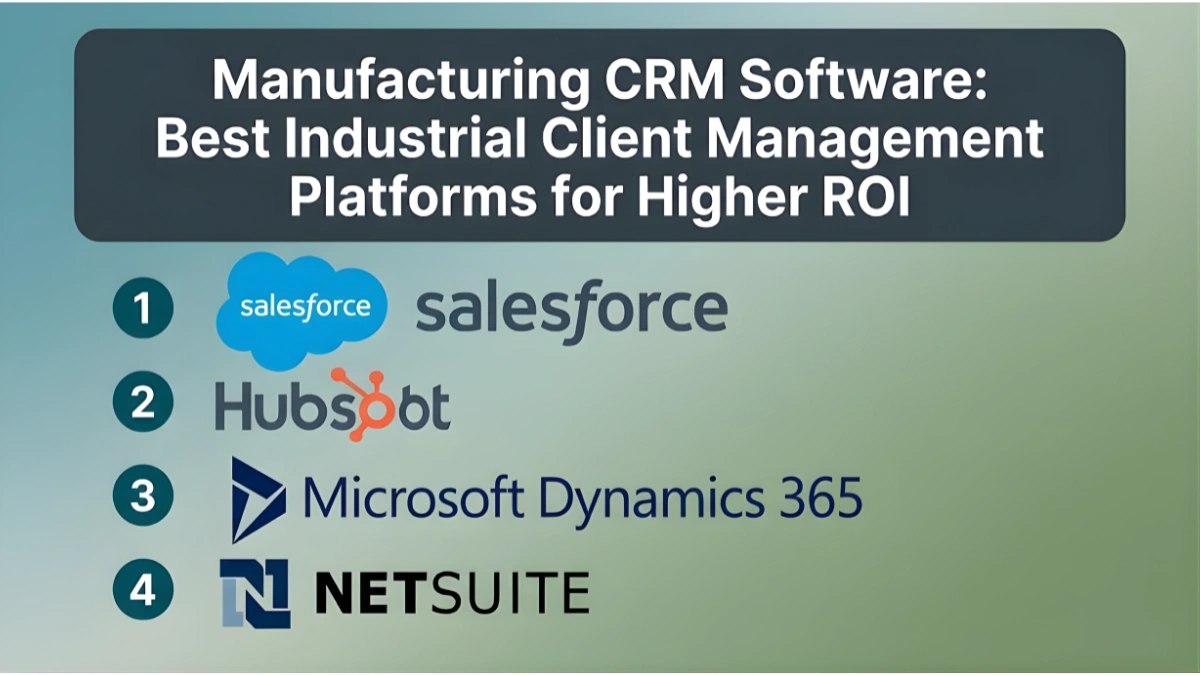
Manufacturing companies now need more than production efficiency because customer communication, forecasting, distributor coordination, and supply chain visibility all influence long-term profitability. In industrial markets, CRM software has become essential because manufacturers often deal with long B2B sales cycles, repeat orders, service contracts, and complex account relationships.
In high-value industrial software sectors, keywords related to manufacturing CRM, industrial automation software, ERP integration tools, and B2B sales systems attract strong advertiser demand because manufacturers actively compare software before investing. CRM adoption is now directly linked to better forecasting and stronger operational control
Why Manufacturing Companies Need CRM Software
Manufacturers manage both customer relationships and production-linked sales cycles, which makes CRM highly valuable.
Main benefits include:
- Centralized client records
- Better demand forecasting
- Automated follow-ups
- Distributor communication
- Service tracking
This improves both production planning and customer retention.
Key Features Manufacturing CRM Must Include
A manufacturing CRM should support both industrial sales and operational coordination.
Important features include:
- ERP integration
- Sales forecasting
- Lead tracking
- Workflow automation
- Reporting dashboards
These features help industrial teams make faster decisions.
Best CRM Platforms for Manufacturing Companies
| CRM Platform | Key Features | Best For | Integrations |
|---|---|---|---|
| Salesforce Manufacturing Cloud | Forecasting, opportunity tracking, AI insights | Large manufacturers | ERP, analytics |
| Zoho CRM | Workflow automation, inventory integration | SMEs and distributors | Inventory, accounting |
| HubSpot CRM | Deal tracking, automation, dashboards | Mid-size manufacturers | ERP connectors |
| Microsoft Dynamics 365 | Supply chain visibility, AI forecasting | Enterprise operations | ERP, Power BI |
Salesforce for Large Industrial Operations
Salesforce remains strong for manufacturers needing advanced forecasting and enterprise integration.
Main strengths:
- Account forecasting
- Production-linked sales visibility
- Enterprise reporting
Zoho for Small and Mid-Sized Manufacturers
Zoho remains attractive because of affordability and flexibility.
Popular strengths:
- Budget-friendly automation
- Easy workflow setup
- Inventory support
HubSpot for B2B Manufacturing Sales Teams
HubSpot works well where manufacturers need easy sales pipeline control.
Main benefits:
- Contact organization
- Sales automation
- Reporting clarity
Microsoft for Complex Manufacturing Networks
Microsoft is highly preferred where large operations already use enterprise systems.
Important advantages:
- Deep supply chain integration
- Forecasting intelligence
- Cross-department visibility
Benefits of CRM in Manufacturing
Manufacturers often report measurable improvements after CRM adoption.
Main gains include:
- Better sales forecasting
- Faster order handling
- Reduced delivery delays
- Stronger customer communication
Best CRM Implementation Practices
CRM works best when fully connected to existing systems.
Recommended steps:
- Connect ERP first
- Train sales and production teams
- Monitor forecasting KPIs
FAQs
1. Why do manufacturers need CRM software?
Because industrial sales cycles require structured account management.
2. Which CRM is best for large manufacturing firms?
Salesforce and Microsoft remain strong choices.
3. Can smaller manufacturers use CRM affordably?
Yes, Zoho and HubSpot fit many SMEs.
4. Does CRM improve supply chain visibility?
Yes, especially with ERP integration.
5. Is CRM useful for forecasting?
Very useful for production planning.
Conclusion: Manufacturing CRM software is becoming essential because industrial businesses now depend on accurate forecasting, stronger distributor relationships, and reliable sales visibility. Companies using the right CRM often improve operational efficiency, customer retention, and long-term production planning.
Disclaimer: This article is for informational purposes only. CRM pricing, industrial integrations, and software capabilities may change depending on provider updates and business requirements. Companies should verify official software details before selecting a platform.